How we work
First we read the public record.Then we write the bid to win.
The three steps, in full
- First we read what is already published about your firm, and what you are going for if you have named it; either way we look for what is open to you.
- Then you get a straight answer, including the answer that there's nothing worth going for.
- Only after that does anything get written, and it gets written against what the buyer actually scores.
The rest of this page takes each step in turn, then sets out what we refuse to do and how every draft is checked.
What is already published about your firm
Councils and funders publish what they bought and what they paid for it. Awarding bodies publish what is open and who it is open to. Contracts name the certificates a supplier has to hold and the date each one runs out. Together that is the public record: everything about your firm that anyone can look up without asking you. Almost none of it is sent to you, and none of it is short.
Before a buyer gives your firm work, they look you up in it. So the first job is reading it properly, from your side for once. We look for work you could go for, for dates that gate contracts you already hold, and for whether the record says less about you than it should. Where the record is thin, we say so and offer you a call rather than guess at the rest. Where there is nothing worth acting on, we say that too, and sell you nothing.
Done by hand, one firm's record is most of a day's work, and a day only buys the places you'd think to look first. We do it in hours, we keep reading after those run out, and a named person reads what comes back before any of it reaches you.
What is published is open to anyone. Which of it we have read, how much of it, and what we take from it is the part you would be paying for.
So there's a boundary, and it is worth naming plainly. Reading what is already published is the free part, and it is where every job starts. The deeper work begins after that, if you decide to take it further.
Public bodies publish how they scored
That first record is about you. There is a second one, and it is about the people doing the scoring. Councils publish their evaluation reports. Complaints boards publish rulings on scoring that somebody challenged. Between them sits the primary record of how these decisions actually get made: real scores, real screen-outs, and the reasoning written down at the time by the people who did the scoring. We work from that record rather than from what the trade says about it.
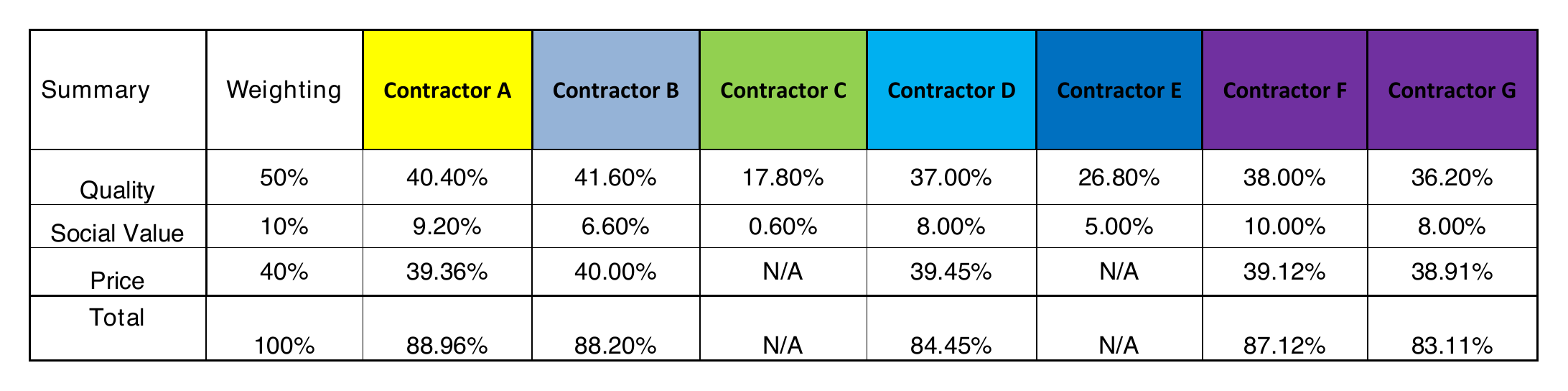
The summary table from Brent Council's evaluation grid for its Diversion from Offending and Early Intervention contract, published with the officer's decision to award on 19 March 2026. The bidders are lettered A to G at source; no person is named in the frame. On a phone the frame holds four columns: Summary, Weighting, the winner and the runner-up. Slide it sideways for the scores; the full table opens on a tap.
Source: London Borough of Brent, Officer Key Decision, Appendix 2, published 19 March 2026, retrieved 3 September 2026.
A short excerpt of a published council paper, attributed and linked in the paragraph below. The document states no licence and carries the council's own copyright line.
One you can read today. Brent Council's own evaluation grid for its Diversion from Offending and Early Intervention contract, March 2026, published with the officer's decision to award. Seven bids went in. Two were excluded before their prices were weighed at all, for scoring too low on individual questions. The bid that won scored 88.96 per cent, and the one behind it 88.20. Nobody hired us for that job, our name appears nowhere in it, and the document is the council's own.
We read Norway's public procurement complaints board the same way, and case 2026/0603, decided in May 2026, is one you can open yourself: a municipality re-scored its bids after finding errors in its first evaluation, and the board found the correction unlawful.
We map what the buyer scores
The scoring scheme sits in the tender documents: what gets marked, and what each part is worth. We read that before we write a word, break every question down against it, and work out what each answer has to earn. Then we draft to that map and nothing else. Where your evidence is weak on a question, we say so and re-aim the answer at something it can carry, rather than filling the gap with sentences a scorer cannot mark. Where it is strong, we write it to win.
Every claim carries the source it came from
Each factual sentence in your draft is labelled with where it came from, your own materials or the notice itself, so you can check any claim without taking our word for it. We are plain about how the work is made. AI handles the structure and first draft; the person whose name is on the firm reviews and refines every submission before it goes out. Then you revise it, you approve it, and you submit it under your own name.
Your sector knowledge is the raw material
You know your sector and we don't, and we will not pretend otherwise. Our job is to take the evidence you already have and put it in front of this buyer in the form they actually score.
What we refuse to do
These are standards, not small print.
We will not invent a win rate. When we have a real rate, you will get the real rate, including the losses.
We will not write two competing bids for the same opportunity, full stop. If we are already working on a tender you are bidding for, we will tell you we cannot take you on, rather than quietly take both.
We will not charge a percentage of what you win. We do not sell refund guarantees or promises to defend an enquiry either. Those are balance-sheet promises, and we could not honestly underwrite them.
We will not pad a bid your evidence cannot carry. If mapping your evidence to the scoring scheme shows it cannot support a competitive score, we say so and decline the work.
We don't guarantee outcomes. The decision belongs to the buyer, and no supplier can promise you theirs.
The gates every draft passes
Before anything reaches you, the draft is checked back against the scoring map, and a named person reads it against what you can actually deliver. In UK central government procurement, PPN 017, the policy notice on AI use in procurement, lets a contracting authority ask whether AI was used and what was done to check it, and it is explicit that the answer must not be scored. What it doesn't do is move responsibility for accuracy off the supplier. That responsibility is why we tag every claim and why a person signs the work off.
The first read is free. You can ask what is out there for a firm like yours, or name the tender, grant or award you are going for. We agree the price before you say yes, and then it holds.
We come back to you the same working day if you ask during UK office hours, the next working day if not.