For care providers
Care work runs on frameworks. We've read how they get awarded.
We read what a care buyer would score you on, and tell you what already scores and where the gaps sit. This is a sector we've read closely, not a claimed track record in it.
Last updated .
How care work is actually awarded
If it feels like care work rarely comes up as a fresh open tender, you are reading the sector right. Most of it is awarded through call-offs. The buyer already holds a pre-agreed list of suppliers (a framework) and draws work down from it instead of running a fresh competition. On its face that looks like a reason not to hire us. A Dynamic Purchasing System (DPS) works the same way but is legally distinct: a closed framework has a fixed supplier list, while a DPS keeps letting new suppliers join for as long as it runs. Across public Contracts Finder award notices (pulled 16 July 2026), roughly 84% of care-sector awards were call-offs, against a 60% general-sector base.
At the two buyers with enough award history in this pull to read clearly, Darlington Borough Council (29 of 29 care awards) and the Department of Health and Social Care (3 of 3), every care award was a call-off. Two smaller buyers showed no call-off awards in this pull, but on a count of 2 each, that's too thin to call a pattern either way.
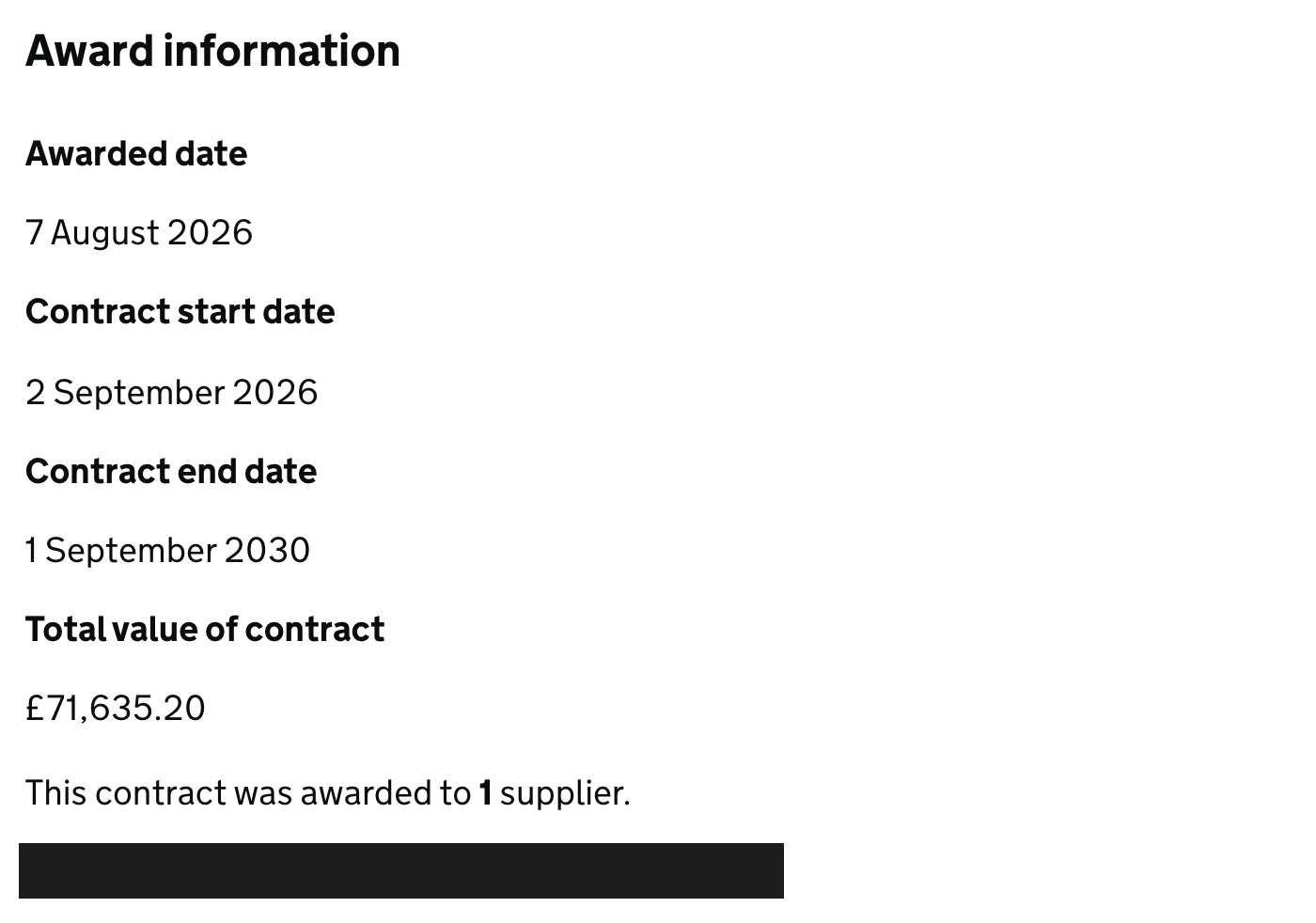
One of Darlington Borough Council's homecare call-offs as published on Contracts Finder, cropped to the award block. The notice's procedure type is a call-off from a framework agreement; it was awarded on 7 August 2026 and published on 28 August 2026. The supplier's name is covered.
Source: Contracts Finder, Homecare Service Placement notice published 28 August 2026, retrieved 3 September 2026.
Contains public sector information licensed under the Open Government Licence v3.0.
This is a structural read of how the route to award works, not a claim about how many contracts exist right now: award volumes move with every pull, and this is a single pull; the call-off concentration is the durable part. Source: public Contracts Finder award notices, pulled 16 July 2026.
So why pay for a fresh submission?
That call-off concentration can look like a closed door: if the suppliers are already chosen, a well-written submission changes nothing. It does, in three places, and here they are.
First, getting onto a framework or a DPS is itself a scored competition, decided on exactly the kind of rubric-mapped, evidence-tagged response we draft, and a DPS keeps admitting new suppliers for as long as it runs, so that door is rarely shut for good. Second, once you are on, most call-offs above the smallest values run their own scored mini-competition, so the writing still decides who wins. Third, knowing when a framework is due to re-open is a timing question: point a free Evidence Read at the notice the moment it lands, and you go in already mapped.
What we read for you
The free Evidence Read works the same way here as everywhere else. We read what is already public about your business and map it against the criteria a care buyer would score you on. Then we tell you what already scores and where the gaps sit.
Mobilisation (starting the contract) and TUPE
If you have ever taken a contract over, you already know the hard part is not winning it, it is the handover. That is mobilisation: the stretch when a contract changes hands and starts. The staff already doing the work usually transfer under TUPE, the law that protects their jobs and terms through the change, and method statements are scored on how you handle that transfer and hold continuity of care through it.
We are not legal advisers and we do not give TUPE advice. What the rubric-mapping stage does is read those requirements straight out of the published pack and flag them, so your own operational answers on staffing, transfer, and continuity land against the criteria that carry the marks.
A council's own scoring, published
You do not have to take the sector fluency on trust. How we work sets out the record we read before we write anything, including a council's own evaluation grid from 2026, with every bidder's score, that anyone can open and check.
See your own evidence mapped
The Evidence Read is free, and there is no obligation to take it any further: